Showing posts with label Diving. Show all posts

Tuesday, January 15, 2013

Mantis Shrimps

Funny thing about perception. When you don't expect something, you often don't see it. For me, one of the interests of diving is to discover creatures I didn't know before. I often poke into holes, turn over rocks to see what's crawling under them and generally become a nuisance to crawly critters under water...

A while back, I noticed a creature I hadn't seen before. It inhabited a perfectly round hole on the crumbly bottom at the foot of the cliff at the mouth of the lagoon. The hole was so perfectly round that I suspected the animal had carved it. It was about three to five centimeters diameter, and the animal occupied the opening completely. As I approached, it retreated inside the hole, but soon came back. Good. I like curious animals, they're fun to play with...


It took me quite a while to identify what I'd seen on the snorkeling outing that day, especially since the only part of that critter I'd seen was a pair of eyes, and the front of the head, or rather what I thought were eyes and head.
After much browsing of "Two Oceans", the excellent book by George and Margo Branch, and some searches on the Internet, I finally settled on a Mantis Shrimp.

The article on Wikipedia about Mantis Shimps, in particular, is very informative for a neophyte like me. A short extract about their eyesight might convince you to pay more attention to these creatures: 
The eyes of mantis shrimp may enable them to recognize different types of coral, prey species (which are often transparent or semi-transparent), or predators, such as barracuda, which have shimmering scales. Alternatively, the manner in which mantis shrimp hunt (very rapid movements of the claws) may require very accurate ranging information, which would require accurate depth perception.
The fact that those with the most advanced vision also are the species with the most colourful bodies suggests the evolution of colour vision has taken the same direction as the peacock's tail.
I have since visited the Mantis Shrimp very regularly at the mouth, Despite searching quite thoroughly, I haven't found another specimen. I have managed to coax it half-way out of its burrow, but not fully out. It has very interesting black and yellow patterns on its carapace and body, but I could not get a good picture because both my hands were occupied trying to make it come out of its hole.

Then, on a dive, I spotted a more colourful one:


Since then, I've been able to spot more and more on the dives.

The fact that they seem to stay in the same place most of the time makes it easy to find them again and again.

One more reason to dive in Bilene...

Dive safely, don't hold your breath!

Daniel                       :-)


<Added a few days later>... a video of one of the encounters. 


I think this is a Lysiosquillina maculata, the zebra mantis shrimp or striped mantis shrimp (see Wikipedia)

A lot more photos on my G+ albums.
A very interesting article in Practical Fishkeeping.

Tuesday, October 23, 2012

Fame at last!

Well, not really Fame as in reporters and paparazzi crowding every street in Bilene to get interviews with us, but a South African magazine recently featured Dive Bilene in one of their article. It's a fairly recent magazine, and of course I bought the current issue that has the article about Bilene in it: http://doitnow.co.za/content/diving-bilene-lesser-known-mozambican-diving-destination
I really like that mag, first of all because it features a lot of the sports and activities I do or have done in the past, and second because there seems to be a wide variety of writers and great photographs.

So do yourself a favor and get it if you don't already have it.

For those, like me, who are not in South Africa, there's a digital edition you can download.

Wednesday, October 10, 2012

Lagoon dives

Diving has been very good lately. When we go outside the bay, we almost always see whales, and hear their song from the moment our ears are underwater and we've calmed enough to actually listen.
I don't know if there are more species, but I have positively identified Southern Right and Humpback whales last week, and quite a few are accompanied by calves.

For divers that have not been in the water for a long while and need to get back underwater gradually, and for divers that are enthusiastic about our artificial reef program, we organize lagoon dives.

I really like lagoon dives. First of all, there is the feeling of "being home". You might live in a nice area, be able to hike in a beautiful forest, but taking a short walk in your backyard does not take away from that beauty. Simply, what's in your backyard is different, and intimately known to you. You probably planted what's there to begin with, and looking at the birds visiting your bird-feeder from the comfort of your armchair is a different activity than going for a hike in the forest.

There are three spots in the lagoon where we go regularly, Legoland, The Graveyard and the Mouth.

We mostly go to the last one, the Mouth, for snorkeling sessions.
On the way, we often spot a flock of Flamingos.
The area covers the base of the rocky cliff, actually not "real" rocks, but ancient coral deposits, a length of about hundred by twenty meters, with barely more than three meters depth.
As you can see, it's well within the reach of beginner snorkelers.

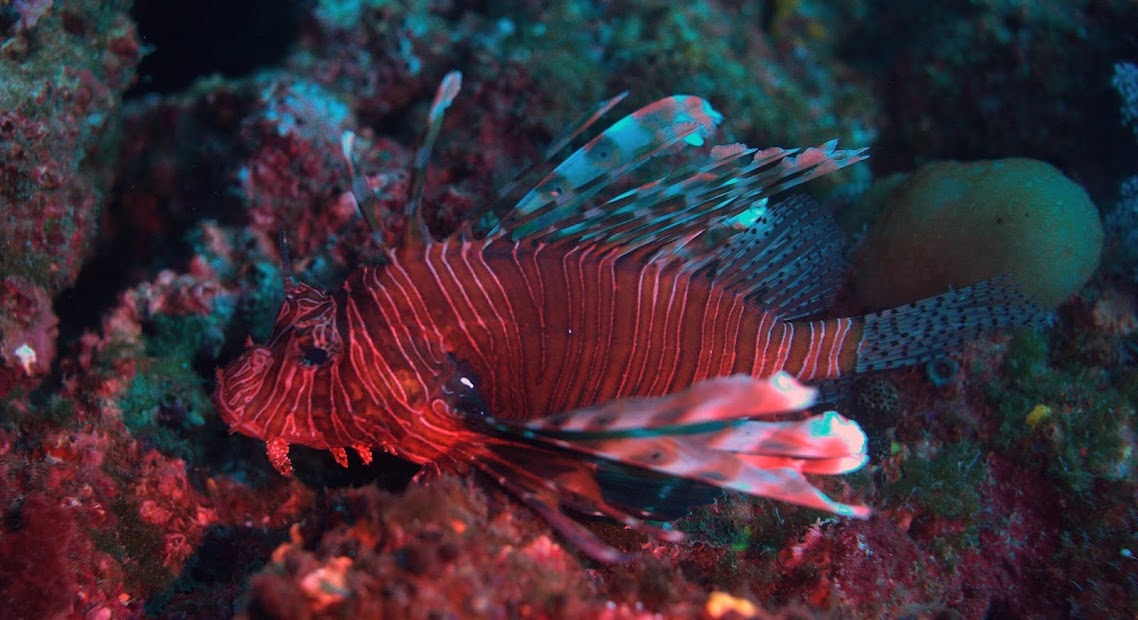
The area is teeming with life. I have spotted Lion Fishes as small as a centimeter in length, among more mature ones of close to twenty centimeters.
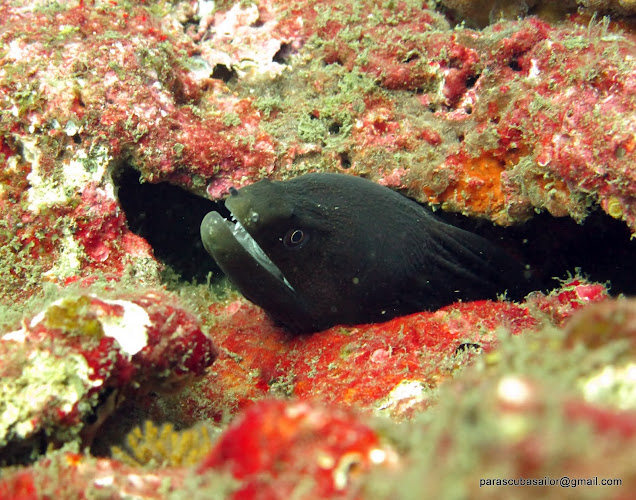
There are also numerous eels, juvenile and mature.

Of course, it's not all about fish, there are also many crustaceans (Cleaner Shrimps, Hermit crabs), gastropods (Cowrie Shells, Nudibranch, Sea-Cucumber, Shaggy Sea-Hare) and of course all the flora.
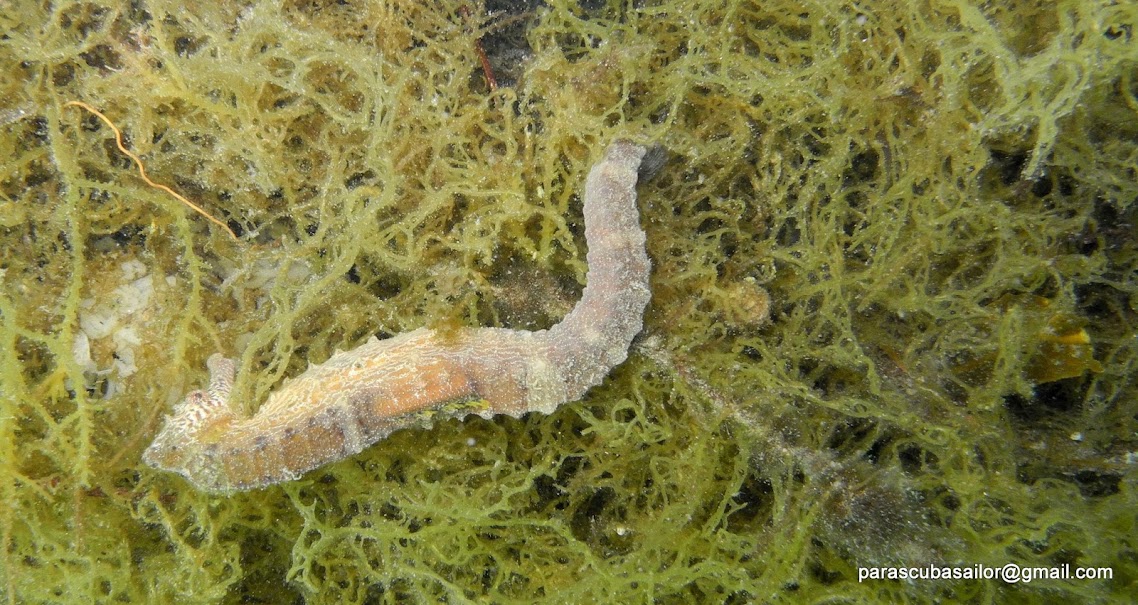
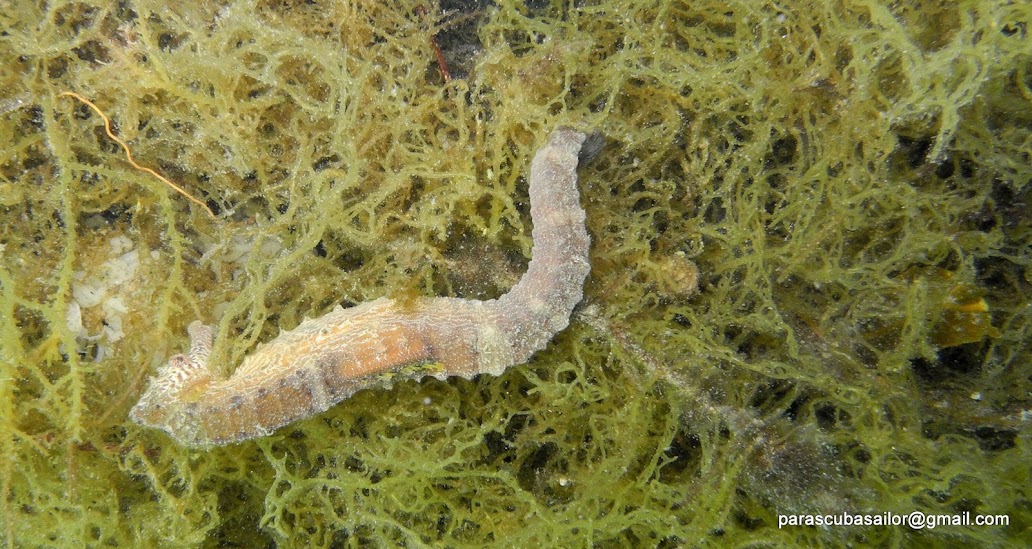
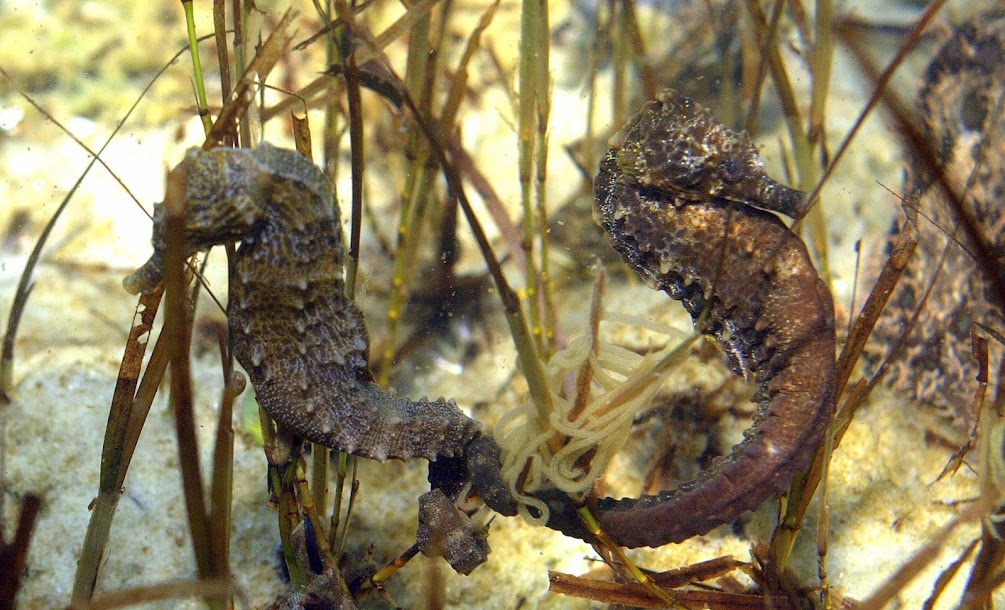
A short distance away, we can observe Sea-horses, 
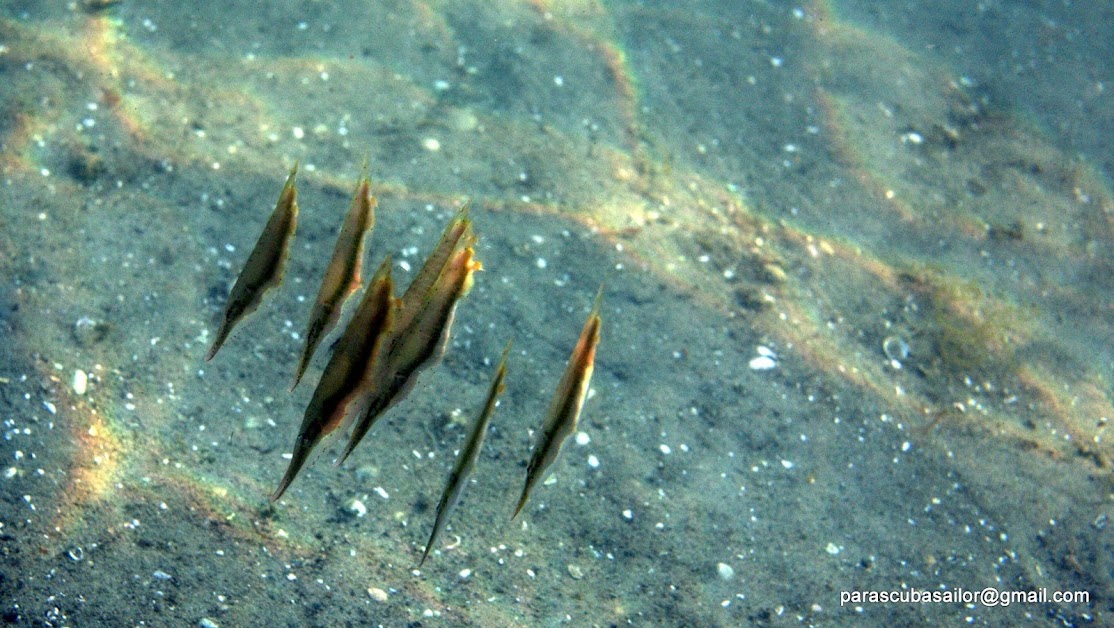
Pipefish and Razor Fish

Closer to the Water Sport Center, we have Legoland. So called because it consists of elements built with concrete blocs, used like one would use Lego blocks to build a playground.
The lagoon bottom is mostly flat sand, so any asperity will offer a refuge to fish and other creature from the fishermen, whose nets don't discriminate between edible and non-edible species, small or big individuals.

In my mind, the presence of so much fish life in the immediate proximity shows the artificial reef is beneficial to the fish population.

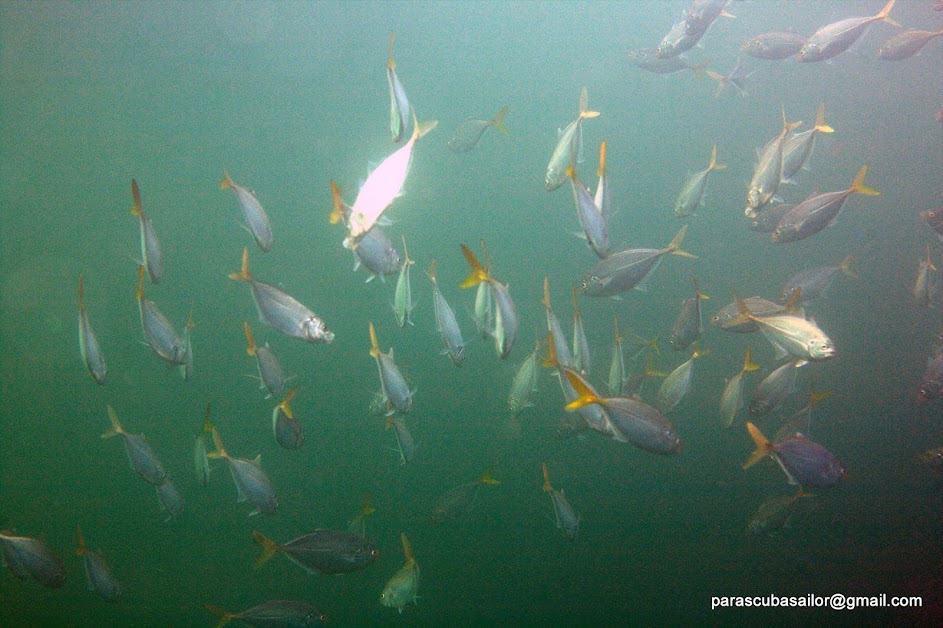
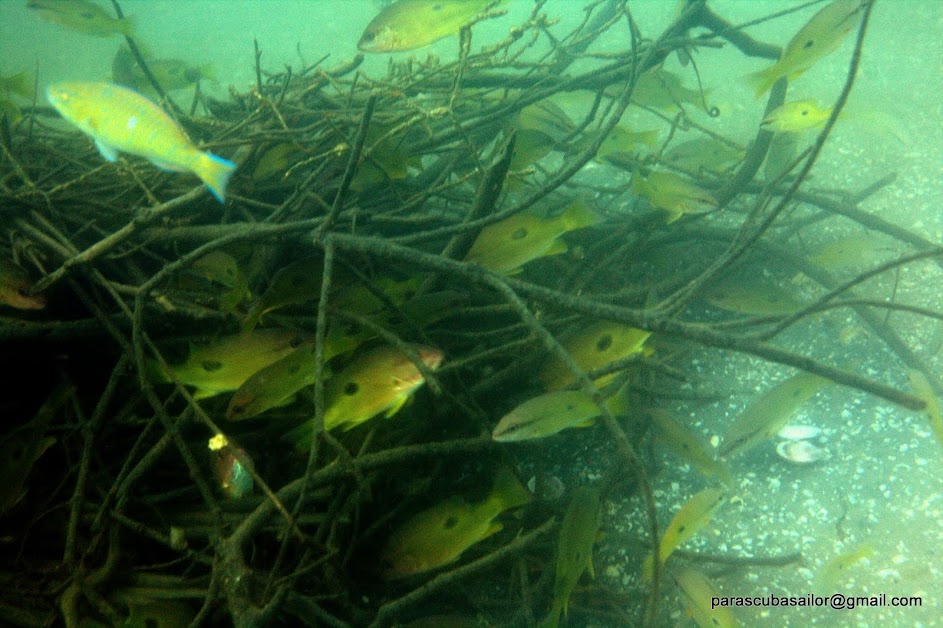
It's not uncommon to have a school of Kingfish circle around us on the way down.
At the bottom, we see quite a few resident Orangespotted Rockcod
Butterflyfish, Snappers, Parrotfish and many others I still haven't been able to identify.

The Graveyard is a different experience. Although the initial motivation in the construction of the reef was to provide a solid surface to which sea creatures would attach, the opportunity for having fun was too strong to resist. The shape of the concrete slabs evolved to resemble tombstones, and that's how the name of the reef was found. For a modest fee (about R100), you can inscribe your own tombstone (mother-in-law's names are popular, and so are the names of competing companies) and sink it yourself.
The rockcods like to hang at the foot of the tombstone.

The reef currently covers an area of over forty meters diameter, with dozens and dozens of tombstones. We also added a few "fish-houses" built with concrete blocks of the same model as Legoland. I have observed clouds of larvae in these fish-houses develop to juvenile fish.

This reef is a favorite destination for night dives, adding to the spookiness of the experience...

So when the tide table doesn't allow us to go out of the mouth, diving inside the lagoon can be an enriching experience.


Stay tuned for more diving news, don't hold your breath,


Daniel     ;-)

Friday, August 31, 2012

Looking for Marine Scientists...

After many discussions with local people and visitors, I've come to the conclusion that the best course of action to improve the survival chances of the seahorses in the area is to get the specie we have here (Hippocampus Camelopardalis) on the CITES list of endangered species.
The way to do that is to have a study published by scientists that shows the decrease in population.
So I'm appealing all that read this blog and their friends, who would like to come to Bilene to study the seahorse population?


This is a job that would be most appealing to someone doing honors, a masters or a phD thesis. Speak around you, let's make things happen...

Tuesday, May 8, 2012

What to do about the disappearing Seahorses?

One of the elements that drew me to Bilene (Mozambique) is the sight of Seahorses.

More of my photos of Seahorses here

Just over three weeks ago, we had a wonderful time looking at dozens and dozens of Seahorses. The next day, I really struggled to find one. I was hoping that the late time of day made it difficult to see them on that afternoon,  but a long swim on Sunday morning confirmed my fears: most of the Seahorses have been fished out. This was further confirmed by some people from our group talking to local fishermen, who were holding handfuls of the dead creatures. This sad occurrence has been on my mind since then, and I'm reaching out to start a discussion and request ideas for a solution.

Wikipedia asserts that over 20 million Seahorses are used every year for medicinal purposes.

While it would be easy to demonize the Chinese people for eating animals we find cute, and dismiss the local fishermen as stupid for trying to earn a living, I believe the roots of the problem lie deeper.

I came across a similar problem in South Africa almost thirty years ago. Perlemoen , the local name of Abalone, was being poached in increasing numbers, mostly because of an increasing demand on the Far East markets, ease of international communication and transport, and increasing standards of living.
Nowadays, despite drastic legislation and big efforts at policing the situation, the poaching still continues and the number of shells found in the wild have plummeted.

I believe the seahorses we have in the Bilene lagoon are Giraffe seahorse . There is some confusion in the endangered status of this species, as the IUCN Red List shows there is no public data available to make a judgement about it. Meantime, Fish Base says " International trade is monitored through a licensing system (CITES II, since 5.15.04) and a minimum size of 10 cm applies."
Very few of the specimen we came across were as big as that, and since this is Africa, there is very little enforcement of the catch size.


The high population resilience characteristic is supported by "minimum population doubling time less than 15 months", but that is little comfort if more than half the population is fished out every year, and more importantly, before the specimen reach sexual maturity.


Therefore, the question I am asking is how best can we address this problem for the long term ?
Should we just shrug, be happy with the memories and photos and accept the unavoidable disappearance of these cute fish?
Should we keep the information about where the seahorses are a secret, and hope the local fishermen don't come across their habitat by chance?
Should we request that the authorities invest more resources into control and repression?


What are your thoughts on the matter? Please use the comments to discuss this issue, suggest possible solutions, or describe schemes that have worked elsewhere.


Stay tuned for more diving news, don't hold your breath,


Daniel     ;-)


Tuesday, May 1, 2012

Mantaaaaaa!

Big excitement! Shortly after we started descending, a Manta Ray came to see what all this agitation was about, and circled us for almost ten minutes.

The viz was rather good, so our group was spread over quite an area, and the Manta came over every single diver, more than once. We had all leisure to examine it, and the six Remoras that accompanied it.

This was really a good start of a dive that will remain in everyone's memory.


I didn't have my camera with me, so I'm relying on Gavin's generosity for the pictures in this post. One advantage to that is that for once there's a pic of me (hello Mom!) :

Gavin's mastery of the underwater colours is outstanding. Here is one of his pics, taken around 12m depth, using only natural light (no external lighting):


Stay tuned for more diving news, don't hold your breath,

Daniel     ;-)


Monday, April 23, 2012

Fantastic conditions

This was a busy week-end with notable visits by a group from Maputo, and Trish and Graham stopping on their way through Africa.

The conditions were the best I've had in Bilene in the last month. The wind had shifted around quite a bit over the past few days, flattening the sea. The calm swell made the launch through the mouth very easy, the smoothest rides we've had so far.


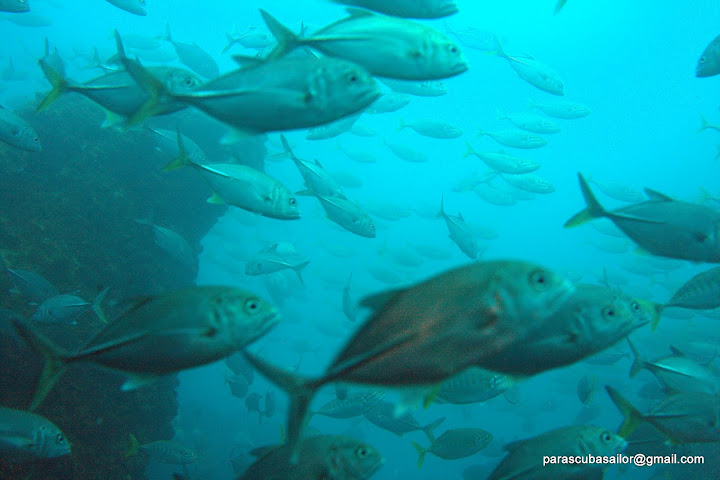
As we dropped, a school of Kingfish circled around us. I'm not sure whether they are resident on the reef, or whether there's a different school every time we dive at Shark Alley.


More photos from the dive here

On this dive, I noticed what I think is an anemone, maybe a tube anemone, but if anyone could confirm, I would appreciate it. When approached, it retracts into the leathery foot very quickly.
If you look at the other pictures, there's another photo of a similarly behaving "anemone", of a different colour.
More photos from the dive here

Some sad news: we went out to look at the seahorses, really struggled to find some, and while we were swimming around some of our group on the beach saw local fishermen with handfuls of seahorses they had just caught. My suspicion is thus confirmed: the seahorses in that spot have been fished out...

More about that in a different post...


Stay tuned for more diving news, don't hold your breath,

Daniel     ;-)


Thursday, April 19, 2012

A couple of dives...

There are very few of us on the boat today, so we load it with spare cylinders and head out for a double-tank dive.
The wind of the previous night has created a cross swell that is a little unpleasant for the ride, but it's still better than some of the conditions we had a couple of weeks ago.
Our first destination, since we enjoyed the dive there so much two days prior, is Shark Alley. On our previous visit, we explored the Northern side, so this time we drop on the South end of the reef.
The viz is not as good as two days ago, but we don't need that much to see the profusion of fish greeting us under the surface.
The reef on this side is very interesting, with huge boulders creating overhangs and caves where the fish seek refuge.
We even see a honeycomb moray eel completely out of its hole, inside a shallow cave.
There is also a profusion of Twobar Clownfish, small and big (Cobus and Ian remark they've seen a pair of the biggest they've ever seen on this dive)

We surface after 46 minutes, having gone all the way to Pride Rock, with still some air to spare, but wanting to keep a decent amount of bottom dive for our next dive.
After changing cylinders, comparing our impressions about the dive, having a bite to eat (for some of us), and stretching our Surface Interval Time, we slowly travel to Babylon.
As is usual on this reef, a huge amount of fish, big and small, awaits us.  One notable encounter is with a curious Trumpetfish:
and of course the encounter with the Scorpionfish just before the end of the dive:
( More photos of this dive here )

Stay tuned for more diving news, don't hold your breath,

Daniel     ;-)

Monday, April 16, 2012

Clearing water, and disappearing seahorses...

Went for a double tank dive today, at Shark Alley (which is becoming my favorite site) and Pride rock. The visibility has been steadily (although too slowly for my taste) improving, each dive reveals bigger and bigger pictures of the reefs structure.
As in previous dive, there was an amazing quantity of fish, big and small, which made the dive very enjoyable.
(More photos from this dive here )

In the late afternoon, we went to our usual spot in the lagoon to spot the seahorses, and I found it extremely difficult to find one, where we spotted dozens yesterday...
(More Seahorse photos here )

Was it too late in the day, was the tide wrong, did they all go to a party where we weren't invited?

Let's see tomorrow if we see them at a different time.

Stay tuned for more diving news, don't hold your breath,

Daniel     ;-)